

U2 Tower, Dublin
Winners of the international design competition and selected from over 600 entries
Project Description
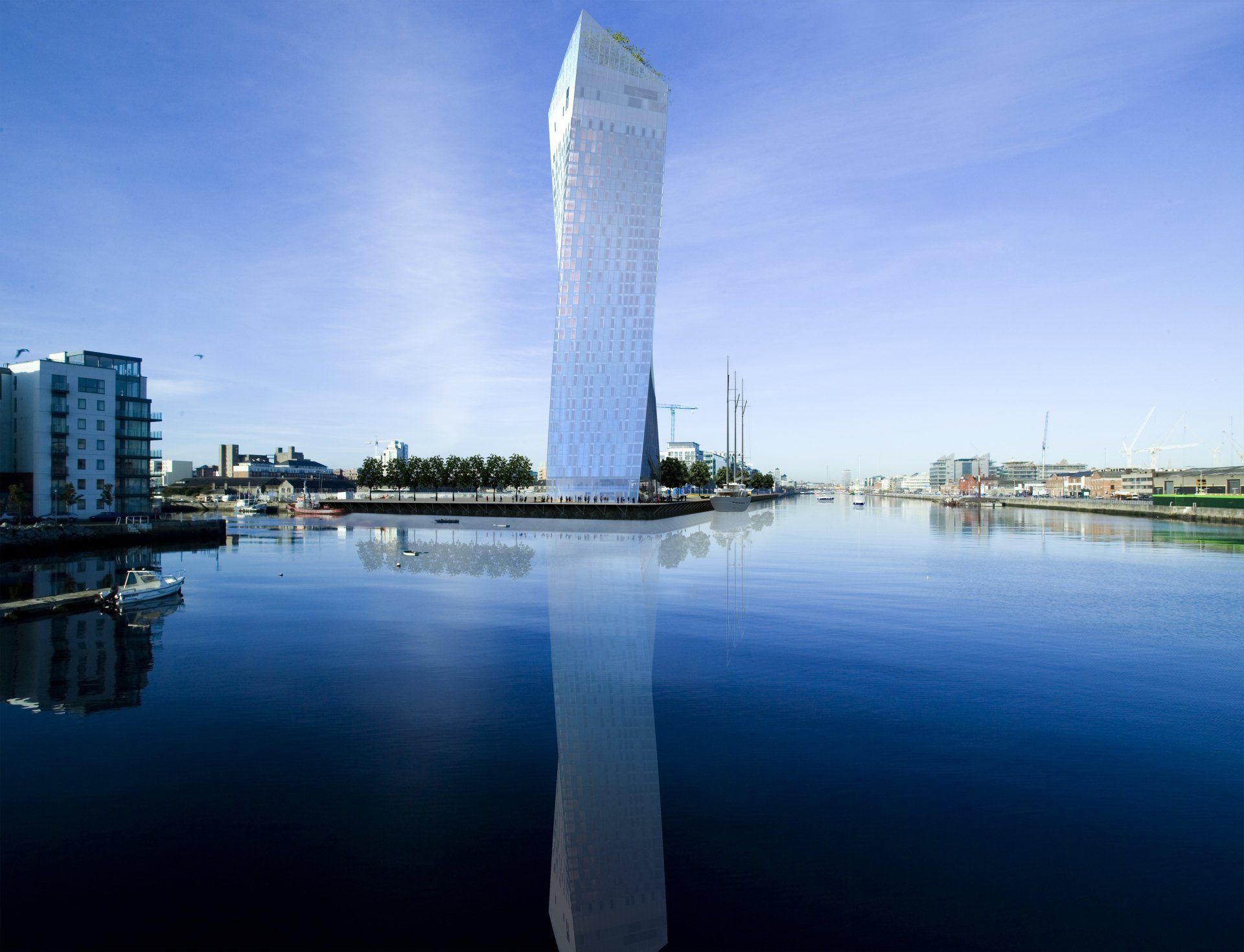
The winner of an international competition run by the Dublin Docklands Development Authority, this proposal was selected from more than 600 entries. The location of the landmark tower is the highly visible junction of the Rivers Liffey and Dodder at the sea approach to Dublin. Originally standing 78 metres tall, the area masterplan was revised to allow a scale increase to 130 metres whilst retaining the tower’s slenderness and dramatic twisting form.
Selected from an international field, a design team of specialist engineers and cost consultants was appointed in 2005 to develop the tower's design through to realisation. The eventual design employed cutting-edge technologies to realise the building's complex form and maximise its floor area within the very restricted site adjacent to two rivers. The building included public functions on the ground-floor levels, 182 highly specified apartments arranged around a central circular core, and a suite of recording studios for the rock band U2. The design was awarded a Section 25 Certificate in August 2006 and issued for a developer tender by the DDDA in November of the same year.
To facilitate the chosen form of procurement for the U2 Tower, the design package included a performance specification, general layouts and indicative details for the key areas of the building, which formed a substantial package of information and covered all aspects of the proposal and was delivered in a very short timescale from the award of the Section 25 application.
The U2 Tower was to be a mixed-use building to be developed at the junction of Sir John Rogerson’s Quay and Britain Quay in Dublin’s docklands. The site is within the administrative area of Dublin Docklands Development Authority and is subject to the provisions of the Dublin Docklands Area Master Plan 2003 and the Grand Canal Dock Amending Planning Scheme, July 2006. The U2 Tower was to comprise a double-height entrance hall, a mix of 1-, 2-, and 3-bed apartments, and a building with a shoulder parapet at 100 metres above street level, crowned with a new recording studio for U2 in a penthouse, to a final height of 134 metres.
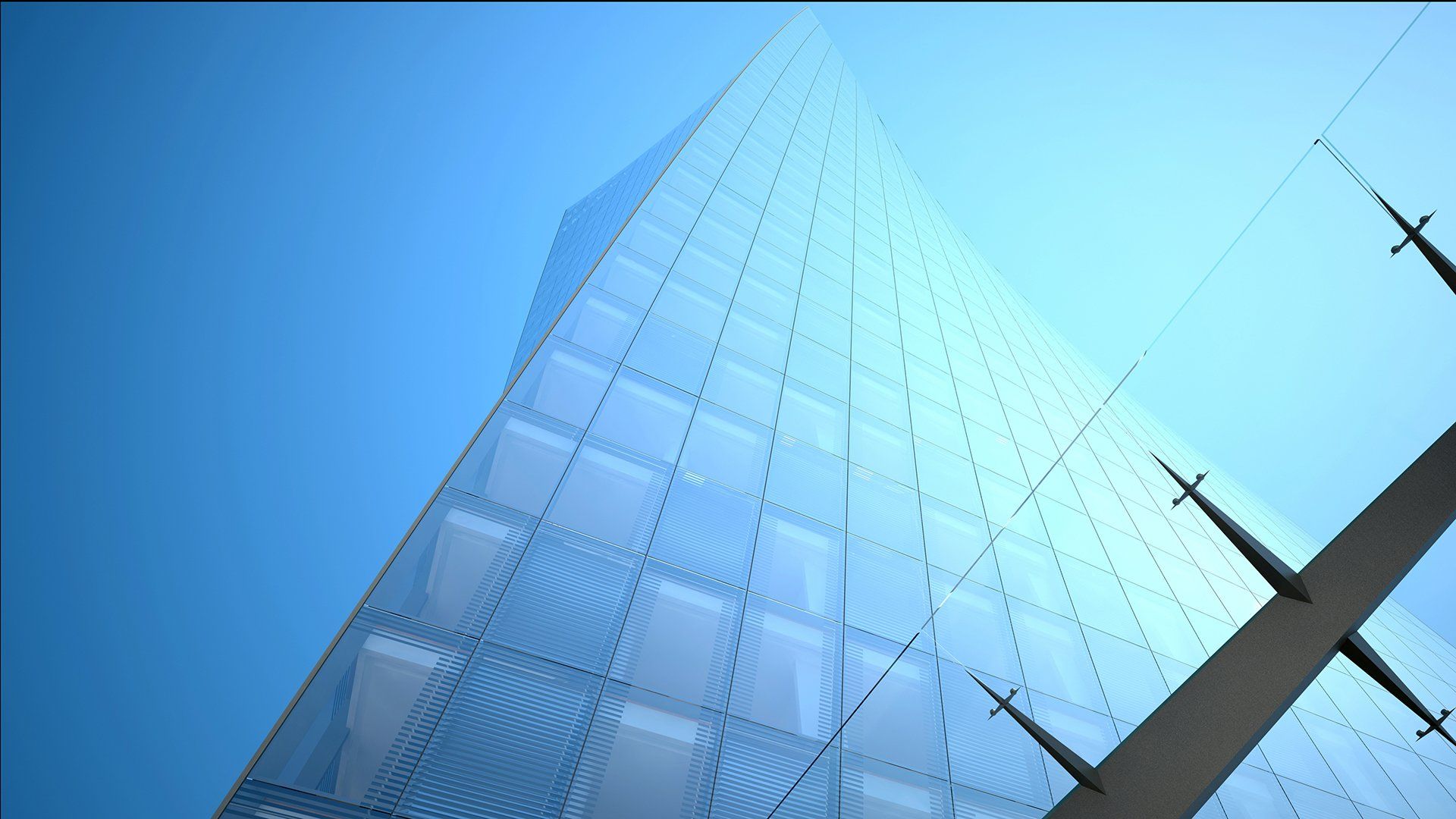
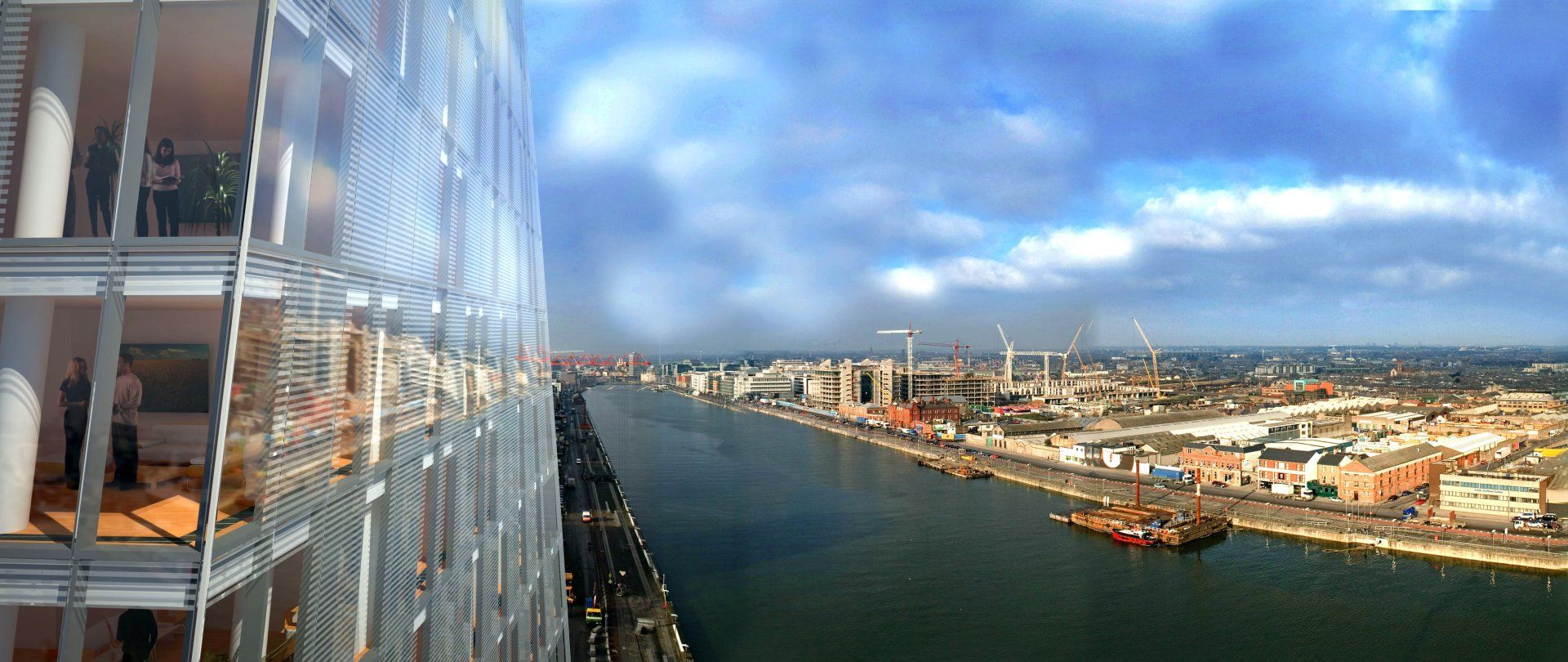
The proposal for the site presented a dynamic, twisted tower, clad in a smooth glazed skin, rising from a canopied entrance plaza on Sir John Rogerson’s Quay and engaging with the historic quay walls at the confluence of the River Liffey, the River Dodder, and the Grand Canal. This landmark, a symbolic beacon at the end of Sir John Rogerson’s Quay, creates a new interface between the regenerated docklands of the static city and the ever-moving river and tidal basins.
At the city scale, our intention was to create an interplay of light, structure, and material that would enhance the public experience and awareness of this new landmark. This individual perception, as part of a shared human experience, can create delight and wonder and strengthen connection to the wider city.
The enclosing skin must perform more than the task of enclosure; it must provide solar protection and, where necessary, privacy, and should contribute to the building's sustainable performance. The façade's depth is detailed to emphasise reflection during the day and luminosity at night; the integration of the architectural lighting strategy reinforces this emphasis.
A transition (services) floor and a ‘multi-purpose’ level separate the residential tower from the recording studio above. The core serving the residential tower terminates at the transition level, while the main staircase and the designated lift, located eccentrically, continue to the U2 Studio above. The transition levels provide total acoustic separation between the two uses and house the M&E plant for both the U2 studio above and the residential accommodation below. The recording studio spans two levels, including a double-height recording studio and control room, as well as reception areas, an office, and ancillary studio spaces.
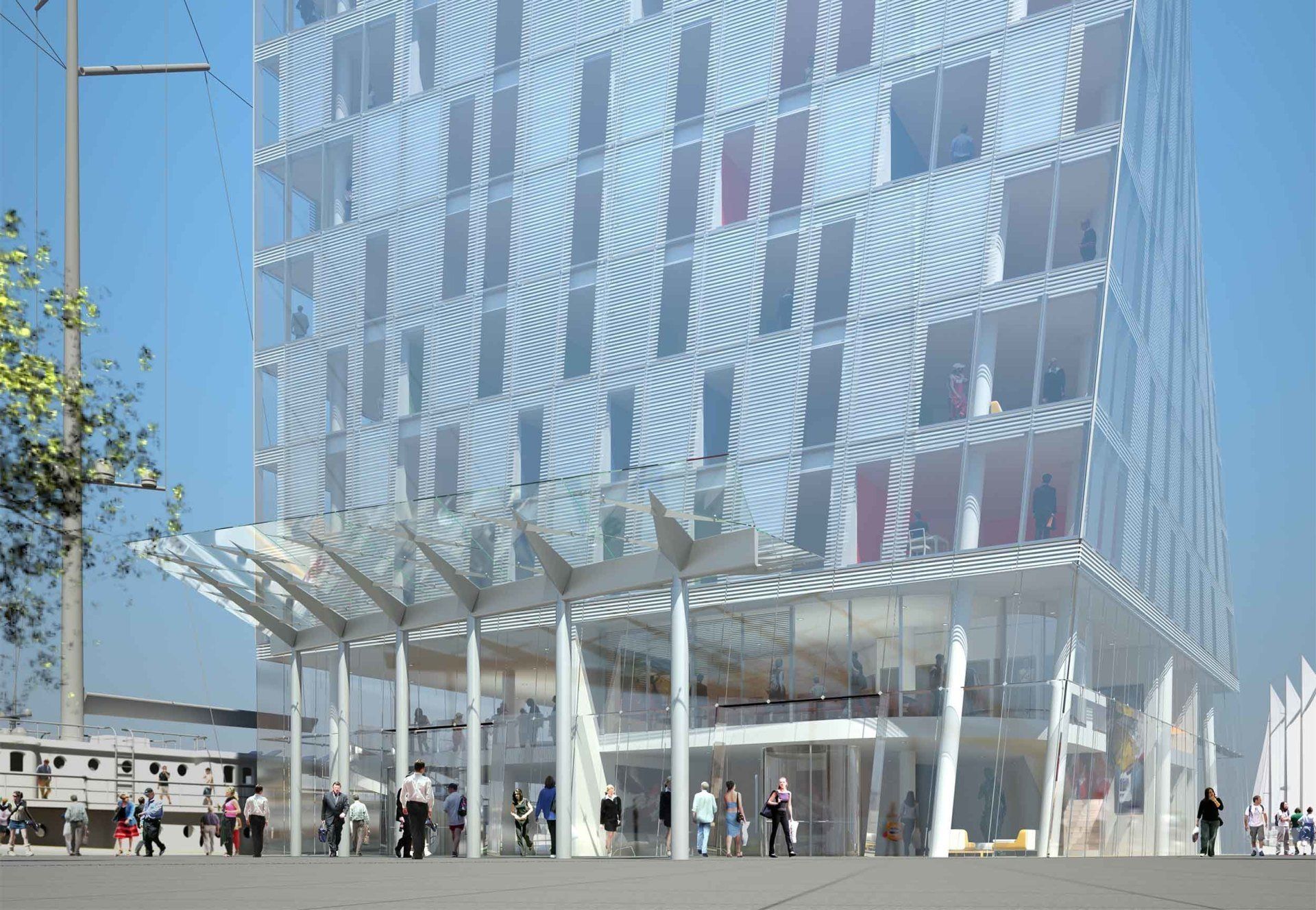
At Campshire level, the building opens out to Sir John Rogerson’s Quay, Britain Quay and the waterside. Overhead, a finely detailed glass-to-glass canopy extends into the tower plaza,, providing protection from inclement weather and serving as a windbreak against downdraughts. The entrance plaza, canopy and double-height entrance hall provide a strong visual base to the tower.
The overall ‘twisted’ form of the U2 Tower is created by rotating the square plan form anti-clockwise around a central axis by 45 degrees over a height of 130 metres. This central axis corresponds to the building's core, and the twist creates a continuous helical form. A 45-degree rotation corresponds to a consistent rotation per vertical metre of 0.3461 degrees, or 1.0729 degrees over the standard residential floor-to-floor height of 3.1m. The twist continues over the entire height of the building.
The slenderness ratio, defined as the tower's height-to-width ratio, is critical to assessing the building's elegance. Given the rotating geometry of the tower, the method of calculating the slenderness is the ratio of the building’s diagonal dimension in plan of 37.6 metres (an agreed methodology over the standard method of using the width of the plan form), with that of the overall height of 130 metres, resulting in a Design Absolute maximum Slenderness Ratio of 1:3.46.
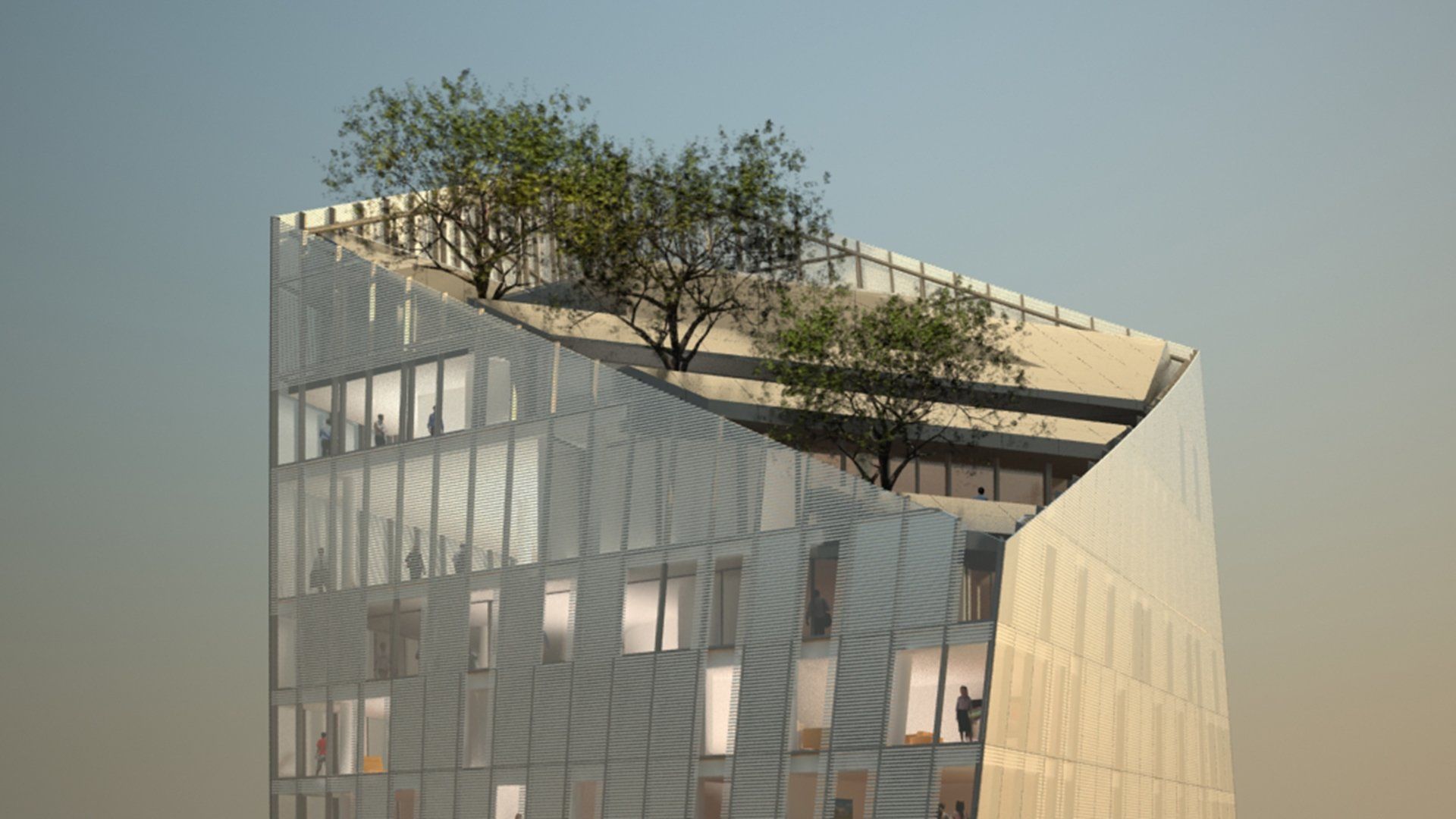
The geometry of the dynamic cut through the top-most section of the building is defined by projecting a straight line cut through the twisted form with a springing point at 106.1m AOD on the ‘Western’ corner of the building and running to the highest point of the tower at 134.1m AOD on the Eastern corner. The cut through the building form also defines the highest points of the North and South corners of the building’s façade at 120.1m AOD. Although the projected cut line is straight, a nuance of the building's twisted form makes the resulting façade edge appear slightly curved.
The cut line also constrains the height of the 'building form' within the facade skin, which is limited such that no part protrudes beyond the cut line. By trimming the building’s form, a series of setback terraces has been created, accessed from the accommodation above the 100m datum. The orientation and extent of the volumes and the terraces on the upper levels have been determined by their rotation in relation to this cut.
Speak to us about your own project
Related Projects